
Williams County Court Records After a Jail Arrest
Court records after a Williams County arrest usually follow a local path: arrest, booking at the Corrections Center of Northwest Ohio, first appearance or arraignment, prosecutor review, filed charge, then docket activity. CCNO serves Williams County adult detainees as a regional jail in Stryker. Its active-offender PDF may show the person's name, booking number, charge text, court, status, in date, and estimated out date, but that roster is not the official court docket.
The court record begins to matter when the prosecutor or court files the charge that will be tracked through the case. For custody, roster, and booking details, use jail inmate records. For booking-photo availability, use jail mugshots. For filed charges, bond orders, pleas, dismissals, sentencing, warrants, and future hearings, use the Williams County Common Pleas/CMS360 route, Bryan Municipal Court, or the Clerk of Courts.
CCNO's first-48-hours information says newly arrested inmates appear before a judge the next regular scheduled court day, typically by video arraignment, although transport to a courtroom can occur. That arraignment reviews bond, determines whether counsel should be appointed, and sets the next court date. The jail record may still show preliminary booking language while the court records after the arrest develop into complaints, indictments, amended charges, or dispositions.
How to Find Williams County Court Records After an Arrest
Start with the court named on the CCNO active-offender entry. Rows connected to Williams County felonies commonly point to Williams County Common Pleas. Rows for misdemeanor traffic or criminal matters often point to Bryan Municipal Court. Federal, ICE, holder, or out-of-county rows need a separate lookup path. Do not assume every row in the CCNO report is a Williams County case just because the person is housed at CCNO.
- Open the CCNO active-offender PDF from the official inmate-search gateway and note the exact name, booking number, case number, court, charge, and status.
- If the court is Williams County Common Pleas, use the county's Domestic and General Courts Records Search page and the linked CMS360 portal, or call the Clerk of Courts at 419-636-1551.
- If the court is Bryan Municipal Court, use the Bryan Municipal Court record search or contact the court at 419-636-6939 for misdemeanor traffic and criminal case information.
- Compare the jail charge text against the court docket. Booking language may differ from the complaint, indictment, amended charge, plea, or final disposition.
- For older files, sealed records, or records not available online, use the Clerk of Courts office route rather than a commercial background-check site.
The Williams County records-search page warns that computerized case information is public information, but the court makes no warranty about accuracy, reliability, or suitability. It also says civil protection order and stalking civil protection order records are no longer available through the internet forum because of 18 U.S.C. 2265(d)(3); those records must be accessed at the Clerk of Courts office.
The county court-records page shows the official path into the Common Pleas search system: Williams County Domestic and General Courts Records Search.
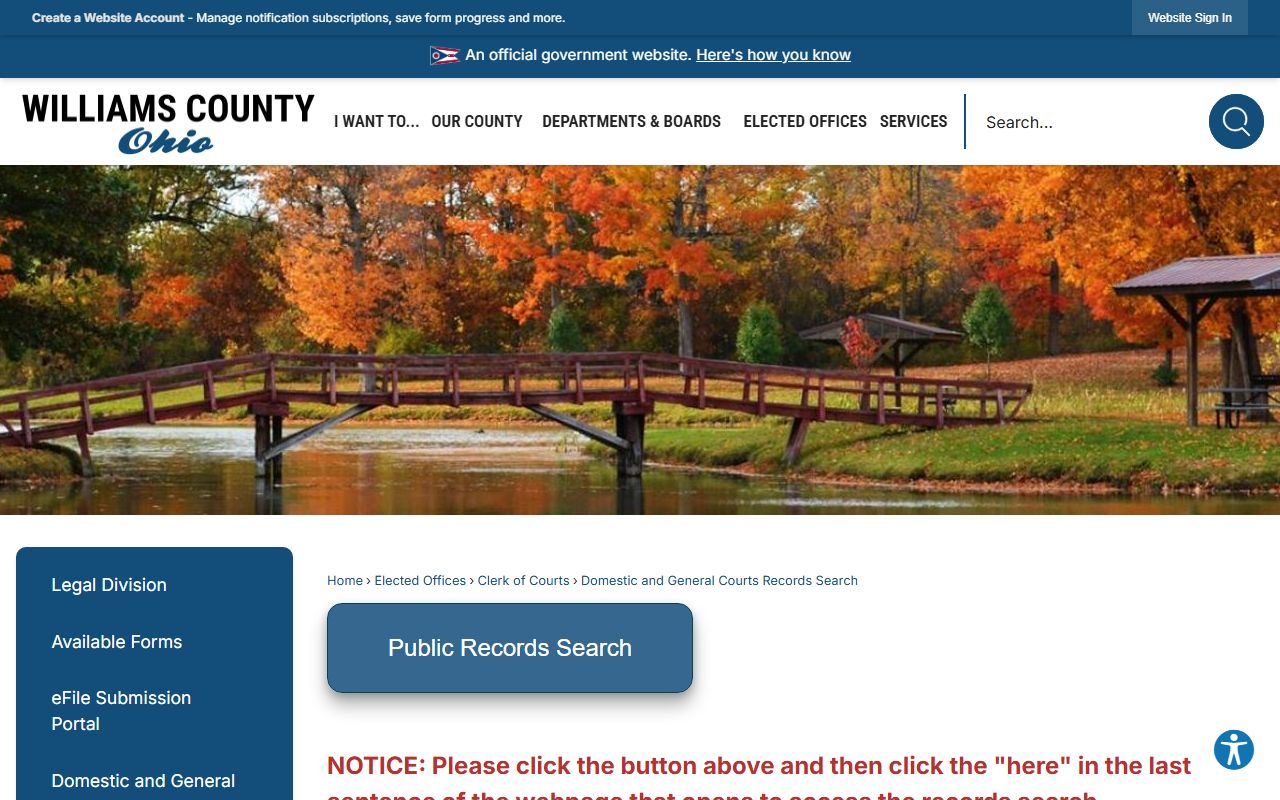
Use that county page as the official starting point before moving into the CMS360 portal, especially when a CCNO row names Williams County Common Pleas as the court.
Common Pleas Felonies and Bryan Municipal Misdemeanors
Williams County uses Ohio's prosecuting attorney system, not a "district attorney" title. The Williams County Prosecutor's Office is led by Prosecuting Attorney Katherine J. Zartman. The office's official materials describe felony criminal prosecution as a primary responsibility, with assistant prosecutors and staff working with law enforcement, pursuing punishment or rehabilitation, protecting the community, and seeking justice for victims.
Felony criminal cases belong in the General Division of Williams County Common Pleas Court. The Williams County Clerk of Courts Legal Division is the record keeper for Common Pleas and Sixth District Court of Appeals cases. That is why a felony arrest can appear first as a CCNO booking row, then later as a Common Pleas docket entry after complaint, information, grand-jury indictment, amendment, plea, or sentencing activity.
Misdemeanor and traffic cases are different. The City of Bryan City Attorney page states that the Bryan Municipal Prosecutor has county-wide jurisdiction over misdemeanor traffic and criminal cases occurring in Williams County and assists villages, townships, and state enforcement agencies. Bryan Municipal Court is at 1399 East High Street, Bryan, Ohio 43506, with Monday-Friday 8:30 a.m.-4:30 p.m. hours, phone 419-636-6939, and email bryanmunicipalcourt@cityofbryan.com.
Charging Documents After an Arrest: Complaint, Information, and Indictment
After a jail arrest, the first public charge language may be short booking text. The filed court record is more formal. A complaint may start a misdemeanor case or begin a felony matter. An information is filed by a prosecutor when allowed by law and procedure. An indictment is returned by a grand jury, and the Common Pleas page specifically describes felony criminal cases as including grand jury matters.
| Document | Who Files or Returns It | Where It Usually Appears Locally | Why It Matters |
|---|---|---|---|
| Complaint | Law enforcement or prosecutor | Bryan Municipal Court or initial felony filings | Starts a case and lists alleged charge facts or statutory charge language. |
| Information | Prosecutor | Common Pleas felony record when procedure permits | Creates a formal charge without relying on the booking row as the final charge text. |
| Indictment | Grand jury | Williams County Common Pleas Court | Shows felony charges returned through the grand-jury process. |
| Warrant or summons | Court or clerk process | Common Pleas or Bryan Municipal Court | May lead to arrest, appearance, or transport to a penal institution. |
Charge Status in Court Records After an Arrest
Charges can change after booking. The CCNO roster may show PRETRIAL, INDICTED, SENTENCED, SENT-PRISON, or HOLDER, while the court docket may show a separate event history. The court record is the better source for amendments, reductions, dismissals, pleas, trial settings, and sentencing. A person can also remain at CCNO on a holder even if one local charge has changed or ended.
| Status | What It Means | Where to Verify |
|---|---|---|
| Pending / Pretrial | The case has not reached final disposition. Bond, counsel, and hearing dates may still be active. | CCNO for custody; court docket for case events. |
| Indicted | A felony charge has been returned by a grand jury and is usually tracked in Common Pleas. | Williams County Common Pleas/CMS360 or Clerk of Courts. |
| Amended or Reduced | The filed charge changed from the original booking or complaint language. | Case docket, plea entry, or judgment entry. |
| Dismissed | The charge ended without a conviction on that count. | Court docket and filed dismissal entry. |
| Sentenced / Sent-Prison | The court imposed sentence; a prison sentence may trigger transfer from CCNO to ODRC reception. | Court docket, CCNO status, then ODRC Offender Search after transfer. |
| Holder | Another court, agency, federal authority, immigration agency, or supervision authority may prevent release. | CCNO phone line, court, ICE, BOP, ODRC, or other issuing authority. |
Bond and Release After an Arrest
CCNO's active-offender PDF inspected during research did not show bond amounts, so the jail roster is not the best final source for bond. CCNO says arraignment addresses bond, appointed counsel, and the next court date. Verify bond through the court named in the roster row, the Clerk of Courts, Bryan Municipal Court, or CCNO by phone at 419-428-3800 when custody or holder status is uncertain.
Bryan Municipal Court publishes specific local bond instructions for misdemeanor traffic and criminal cases. Bond may be posted at the court from 8:30 a.m. until 4:30 p.m. Monday through Friday. At other times, Bryan Police Department at 103 North Beech Street can accept cash and credit-card bond on misdemeanor traffic and criminal cases. Credit-card access fees are non-refundable. Felony bonds may only be posted in cash, and the police department is not authorized to accept surety bonds.
| Bond Type | How It Works | Williams County Checkpoint |
|---|---|---|
| Cash Bond | Money is posted directly as ordered by the court. | Confirm whether the case is municipal, common pleas, federal, or another jurisdiction. |
| Surety Bond | A surety or bail bond agent posts if the court allows that type of bond. | Bryan Police cannot accept surety bonds for after-hours municipal bond posting. |
| Recognizance | Release is based on a promise to appear and comply with court conditions. | Look for the court order or docket entry, not just the jail status. |
| No-Bond or Holder | Payment may not secure release because another authority controls custody. | Check for federal court, ICE, parole/probation, SENT-PRISON, or HOLDER rows. |
Warrants That Lead to an Arrest
No official Williams County sheriff active-warrant search page was located in the reviewed sources. The best local route is to identify the issuing court. The Williams County Clerk of Courts page says the clerk issues writs to carry out court orders, including summonses, subpoenas, and warrants to arrest and convey to penal institutions. For Common Pleas bench warrants or felony case activity, use the Williams County records portal or call the Clerk of Courts. For municipal misdemeanor or traffic warrants, check Bryan Municipal Court directly.
CCNO entries can show warrant-related charge text such as arrest for failure to appear or issuance of warrant, but the CCNO PDF is a custody roster, not a complete warrant database. A warrant lookup should use court records after the arrest, the sheriff's office for agency-created arrest or service records, ODRC for parole violator status, or federal sources for USMS matters. Do not call 911 for routine warrant questions.
Charges vs. Convictions
A charge after a Williams County jail arrest is an accusation or holding basis. A conviction is a court outcome after a plea, verdict, or other final adjudication. Public records may show both, but the meaning is different. Treat a CCNO roster charge, a complaint, or an indictment as pending unless the court record shows a conviction, dismissal, acquittal, or sentencing entry.
| Charge | Conviction | |
|---|---|---|
| Stage | Accusation or filed count after arrest. | Final court outcome by plea, verdict, or finding. |
| Proof Level | May begin with probable cause, complaint, information, or indictment. | Requires a plea or proof beyond a reasonable doubt for trial conviction. |
| Record Location | May appear on CCNO roster and court docket. | Should appear in the court's judgment, sentencing, or disposition entry. |
| Practical Effect | Can affect custody, bond, and hearing schedule. | Can affect sentence, supervision, ODRC transfer, fines, and eligibility for record sealing. |
Sealed vs. Expunged Arrest Records
Ohio record clearing is a legal process, not a jail-roster edit request. If a Williams County court record after an arrest is eligible for sealing or expungement, the person normally works through the court that handled the case. A dismissal, acquittal, or old conviction does not automatically remove every public reference from every agency system without the proper court order and record-holder processing.
| Sealed | Expunged | |
|---|---|---|
| Visibility | Hidden from ordinary public access, subject to legal exceptions. | Destroyed, deleted, or treated as removed where Ohio law allows. |
| Agency Access | Some courts, law enforcement, or licensing entities may retain limited access. | Access is more restricted, but depends on the statute and order. |
| Local Step | File or verify the order in the court that handled the Williams County or Bryan Municipal case. | Ask the court and record holder how the expungement order affects public jail and court access. |
| Not a Shortcut | Does not erase a case just because the charge is embarrassing. | Does not force unrelated third-party sites to act unless a legal remedy applies. |
Public Records, Restricted Records, and VINE
Ohio's Public Records Act, ORC 149.43, is the main public-access statute for records held by public offices, subject to exemptions. CCNO accepts public-records requests by email at ccnoregional@gmail.com, by mail to Public Records Request, CCNO, 03151 County Road 2425, Stryker, OH 43557, in person during Monday-Friday 8:00 a.m.-4:00 p.m. public-records office hours, or by phone at 419-428-3800 ext. 201. CCNO lists a separate copy fee for 8.5 x 11 single-sided public records.
For sheriff-created arrest or incident records, use the Williams County Sheriff's Office, led by Sheriff Thomas Kochert, at 1425 E High Street, East Annex, Bryan, OH 43506, or email wcso@bright.net. The sheriff's policy says public records are available between 8:00 a.m. and 4:00 p.m. weekdays except county-adopted holidays, and responses must comply with ORC 149.43 after examination and redaction.
Some records are not broadly public online. Juvenile records, sealed cases, civil protection order records removed from internet access, medical information, Social Security numbers, confidential law-enforcement investigatory records, victim or witness safety information, and records prohibited by state or federal law may be withheld or redacted. VINE and VINEMobile are notification tools for custody and criminal-case updates in Ohio; they are useful for victims and concerned citizens, but they are not a substitute for the court docket or CCNO custody verification.
FCRA notice: This site is not a consumer reporting agency. Do not use these records for employment, tenant, credit, insurance, or other FCRA-regulated decisions.
Public Record Search
Sponsored Results